Why Use The Spark API Instead Of RETS?

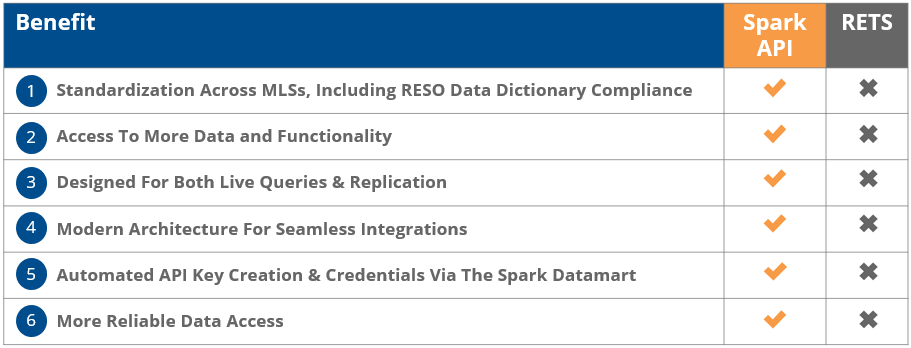
See the table below for a more detailed comparison between the Spark API and RETS.
Benefit | Spark API | RETS | |
|---|---|---|---|
 | Field Standardization, Including RESO Data Dictionary Compliance | A greater level of field standardization across MLSs. The RESO Web API, which sits within the Spark API, returns Flexmls data in standardized RESO Data Dictionary fields for maximum compatibility across multiple MLSs. | RETS field names are not human-readable and are not consistent among MLSs. |
 | Access To More Data & Functionality | Provides Access To More Data The APIs include the same resources as RETS and many more, including the following:
Tip: The Spark API also supports writing data back into Flexmls, allowing for two-way syncs, updates to contacts and listings, and more. | Provides Access To Less Data
RETS doesn’t support any writes back to Flexmls. |
 | Designed For Both Live Queries & Replication | Supports live queries where users request data from the API in real time and pass the response to their website or app’s user. The API also accommodates specific requests, allowing users to pull only the data they need. | RETS requires users to download data to their own local database for use. |
 | Modern Architecture For Seamless Integrations | Seamless integration into modern technology stacks, with less overhead required for developers to work with an unfamiliar system. | A legacy system built on outdated technology. |
 | Automated API Key Creation & Credentials Via The Spark Datamart | Do it yourself! The Spark Datamart automates the process of developers and agents requesting API credentials, bringing licensing terms, pricing, and approvals together in one secure, convenient online space. In the Spark Datamart, MLSs can offer data plans (VOW, IDX, etc.) and make them accessible for brokers, agents, and third-party developers to license. | RETS requires someone to manually set up everything for you. |
 | More Reliable Data Access | With the Spark API and our RESO Web API, far more listing data is accessible with a single request, reducing the chances of failed requests leaving holes in your data. | RETS requires many individual requests to pull all the data for a specific property. |